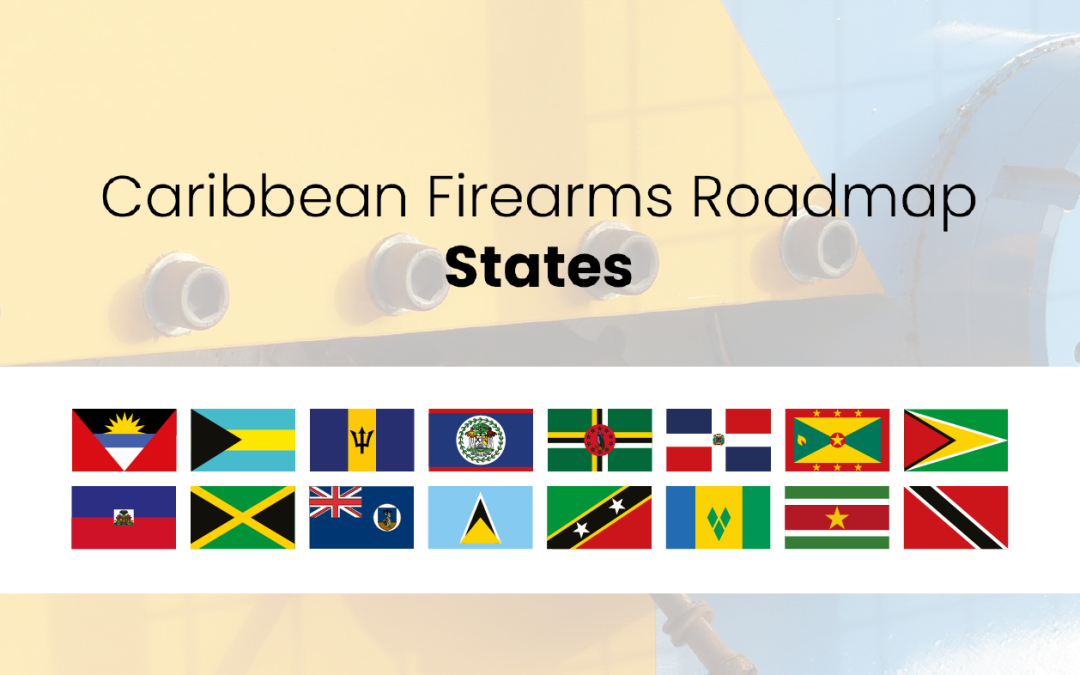
Insights from the Caribbean Firearms Roadmap States

Insights from the Caribbean Firearms Roadmap States

Commonwealth of the Bahamas

Author: The Honourable Wayne Monroe, Minister of National Security Commonwealth of the Bahamas

A crisis this complex cannot be solved by one party, one agency, or one group alone. That is why a whole-of-government and a whole-of-society approach is necessary.

Law enforcement must be supported with smart, targeted strategies and resources to rid illegal guns off our streets and hold violent offenders accountable. […]

Comments on the Findings and Recommendations of the Mid-Term Review of the Roadmap

Author: The Honourable Juliet Cuthbert-Flynn, O.D., M.P., Minister of State, Jamaica

The Mid-Term Review has provided a timely opportunity to evaluate how the Roadmap’s priority areas are being implemented across participating states, including Jamaica, and the impact of this important regional initiative.

The review has highlighted some areas of progress, ongoing challenges and strategic actions proposed to strengthen the Caribbean’s collective response to illicit firearms proliferation. […]

Guyana emphasizes strides in legislative reform under the Caribbean Firearms Roadmap

Author: Jasmin Louisy, Representative of Ministry of Home Affairs, Guyana

Through collaboration and technical assistance, Guyana has demonstrated tangible successes under the roadmap, making strides in legislative reform with a draft firearms control bill, improved firearms tracing mechanism with the assistance and donation of the BRASTRAX Acquisition Centre through CARICOM IMPACS creating regional tracing capabilities, increased capacity building for investigative officers, customs officers, ballistics officers, and airport staff etc. and commenced addressing the physical security and stockpile management of SALW. […]

Previous posts

Antigua and Barbuda

Author: Travis Crump, Sergeant, Royal Police Force of Antigua and Barbuda

As the Focal Point for Antigua and Barbuda, I write to share on the progress in Implementing the Caribbean Firearms Roadmap from my point of view.

Antigua and Barbuda’s National Action Plan (NAP) under the Caribbean Firearms Roadmap (CFRM) has seen notable successes and challenges since its inception. […]

Commonwealth of the Bahamas

Author: Jennifer Bethel, Director of Research and Development Section, Ministry of National Security

The Bahamas’ National Action Plan was approved in 2024 by the Cabinet of The Bahamas. With approval, the National Committee sought to operationalize the Caribbean Firearms Roadmap using select priority areas that aligned with national context. Specifically, The Bahamas assessed its priority areas and chose context-driven actions that would serve to advance the State’s efforts to combat firearms trafficking across the four main goals. […]

Trinidad and Tobago

Author: Renee Adimoolah, nternational Affairs Coordinator, Ministry of National Security

Trinidad and Tobago’s approach to developing a National Firearms Action Plan, reflects a desire to design an effective strategy that fosters inclusivity and shared responsibility amongst stakeholders, as well as address the root causes of firearms proliferation. Additionally, the approach acknowledges that for the Plan to be sustainable, robust monitoring and evaluation mechanisms must be integrated into the overall framework from the beginning. […]

Commonwealth of the Bahamas

Author: Jennifer Bethel, Director of Research and Development Section, Ministry of National Security

The Government of The Bahamas understands that safety and security undergirds the nation’s socio-economic development. The Government is keenly aware that regional security is a concern that involves threats to both the safety and stability of the Caribbean. […]

Antigua and Barbuda

Author: Atlee Rodney, Commissioner of Police, Royal Police Force of Antigua and Barbuda

Greeting from the twin island state of Antigua and Barbuda. In recent years, the Caribbean has encountered a growing challenge: the illicit trafficking of firearms and by extension, humans through our region. In Antigua and Barbuda, we’re all too familiar with the consequences of this pervasive issue, which not only threatens public safety but also hinders our nation’s progress. As we navigate these complexities, the UNLIREC Caribbean Firearms Roadmap has emerged as a beacon of hope in our efforts to enhance security and reduce firearm-related crimes. […]
Haiti

Author: Ralph Stanley Jean Brice, Inspector General, National Police of Haiti

The implementation of Haiti’s National Action Plan for the Caribbean Firearms Roadmap has been marked by a number of challenges to overcome, but also by notable accomplishments so far. […]


Women, Forces of Change | Symposium 2025

Women, Forces of Change | Symposium 2025

True to its long-standing commitment to gender equality, UNLIREC commemorates the 15th anniversary of United Nations General Assembly Resolution 65/69 on Women, Disarmament, Non-Proliferation and Arms Control (8 December 2010) with a Regional Symposium bringing together more than 50 women leaders from Latin America and the Caribbean.

The event convenes women from diverse sectors and backgrounds who contribute to building more peaceful and secure societies. Through this initiative, UNLIREC seeks to highlight their contributions and inspire new generations of women.

It is important to recall that Resolution 65/69 calls upon Member States to promote and support the effective participation of women in all decision-making processes related to disarmament and security. The Symposium will serve as a platform for dialogue and reflection on progress made, challenges faced, and strategies to advance the implementation of this commitment.

Objectives

  • To highlight progress, good practices, and challenges in promoting women’s participation in the field of disarmament and arms control.
  • To foster dialogue among policymakers, experts, academia, and civil society on gender-responsive disarmament processes.
  • To reaffirm commitments and explore synergies with other international frameworks (such as the Women, Peace and Security Agenda; the 2030 Agenda for Sustainable Development; Youth and Disarmament; and the Pact for the Future, among others).
  • To emphasize the role of youth in advancing women’s participation in disarmament, arms control, and non-proliferation efforts.

For further information please contact: secretary@unlirec.org.

5th Annual Meeting of States of the Caribbean Firearms Roadmap

5th Annual Meeting of States of the Caribbean Firearms Roadmap

From 11 to 12 November 2025, officials from the Caribbean Community (CARICOM) and the Dominican Republic will gather in Trinidad and Tobago for the 5th Annual Meeting of States of the Caribbean Firearms Roadmap.

This Annual Meeting of States marks a significant milestone: the midpoint of the Roadmap’s implementation period. As outlined in the Joint Statement from the 3rd Annual Meeting of States, the 5th of such meetings is to also provide a platform for CFRM States to discuss the recommendations resulting from the “mid-term review on the implementation of the Roadmap.”

The meeting is organized by the CARICOM Implementation Agency for Crime and Security (IMPACS) and the United Nations Regional Centre for Peace, Disarmament and Development in Latin America and the Caribbean (UNLIREC) in collaboration with the Government of Trinidad and Tobago.

The meeting, which is funded by Canada, envisages a one-day working level exchange between national focal points established under the Caribbean Firearms Roadmap as well as a high-level meeting of Ministers on 12 November.

This milestone meeting offers a timely opportunity to celebrate progress, address ongoing challenges, and collectively chart the course for the next five years and beyond for the Caribbean Firearms Roadmap.

For further information please contact: secretary@unlirec.org.

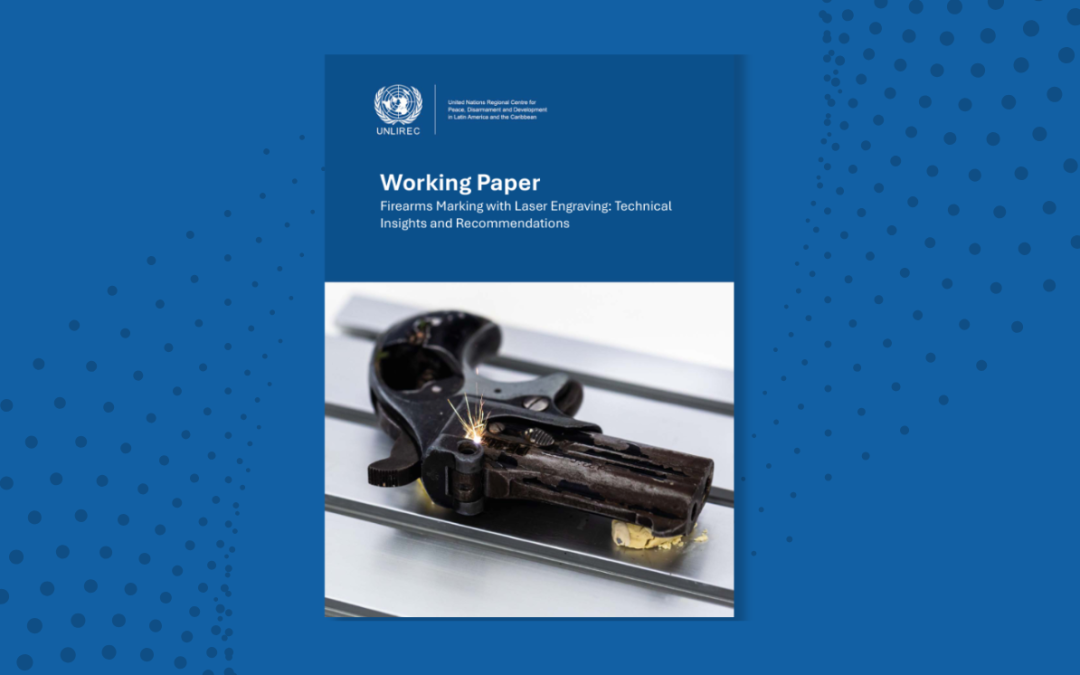
Working Paper – Firearms Marking with Laser Engraving: Technical Insights and Recommendations

Working Paper – Firearms Marking with Laser Engraving: Technical Insights and Recommendations

Marking is a critical element in arms control, aiding with effective stockpile management, preventing the diversion of firearms into illicit markets, countering illicit trafficking and ensuring the traceability of firearms in criminal investigations.

This paper explores the use of laser engraving technology for firearm marking in accordance with international and regional instruments, including the Programme of Action on Small Arms and Light Weapons, the International Tracing Instrument, the Firearms Protocol, and the Inter American Convention against Illicit Trafficking and Manufacturing of Firearms, Ammunition, Explosives and other Related Materials, as well as best practices for firearms marking outlined in module 05.30 on marking and record-keeping of the Modular Small Arms Control Compendium (MOSAIC).

The paper presents findings of experimental research aimed at identifying the optimal applications of laser engraving for marking firearms to prevent, to the extent possible, their obliteration, and to ensure, as far as technically possible, their recoverability.

Central America and Dominican Republic Firearms Roadmap

Central America and Dominican Republic Firearms Roadmap

In February 2025, Central American States and the Dominican Republic adopted the Roadmap to Prevent the Illicit Trafficking and Proliferation of Firearms, Ammunition and Explosives, reaffirming their commitment to a safer future for all.

The Roadmap establishes a comprehensive and coordinated framework to prevent and combat the illicit trafficking, manufacture, and proliferation of firearms, ammunition and explosives, with the vision of creating a sub-region recognised for its intergovernmental collaboration and inter-institutional cooperation, in which security fosters development and strengthens peace.

A Strategic Agenda based on Priorities

The Roadmap is based on four main pillars:

  1. Reinforce regulatory frameworks and inter-agency coordination.
  2. Prevention of violence with firearms and firearms misuse.
  3. Life-cycle management of weapons, ammunition, and explosives.
  4. Investigation and criminal prosecution of trafficking, manufacture, possession and illicit use of firearms, ammunition, and explosives

A 10-Year Action Plan

The implementation period is 10 years (2025-2035), during which national and subregional policies, plans and strategies will be promoted based on effective interinstitutional cooperation and coordination to achieve the objectives and priority actions of each pillar. Its comprehensive and multidimensional approach will also strengthen synergies with broader security and development policies.

The Roadmap includes a monitoring and evaluation mechanism to measure progress of its implementation.

International Support and Cooperation

The development of the Roadmap and its implementation are supported by the Department of Public Security (DPS) of the Organization of American States (OAS) and the United Nations Regional Centre for Peace, Disarmament and Development in Latin America and the Caribbean (UNLIREC), with technical support from the Central American Integration System (SICA).

The development of the Roadmap between 2023 and 2024 was funded by the European Union.

The implementation of the initiative is expected to bring together States, custodians, implementing partners, donors and other stakeholders in a joint effort to ensure its success and sustainability.

Participating States

Belize, Costa Rica, El Salvador, Guatemala, Honduras, Panama and Dominican Republic.

Fact Sheet

Central America and Dominican Republic Roadmap to Prevent Illicit Trafficking and Proliferation of Firearms, Ammunition and Explosives

Publications

Central America and Dominican Republic Roadmap to Prevent Illicit Trafficking and Proliferation of Firearms, Ammunition and Explosives

Adoption

Ministers of security and high-level officials from six Central American countries and the Dominican Republic will adopt the Roadmap on 12 February 2025

News